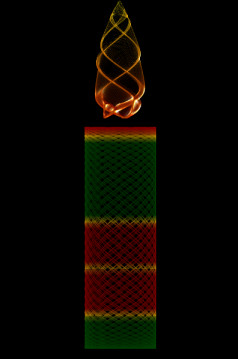
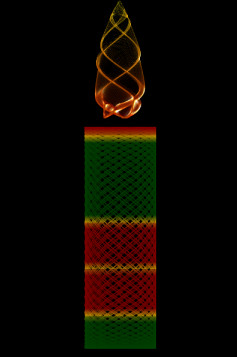
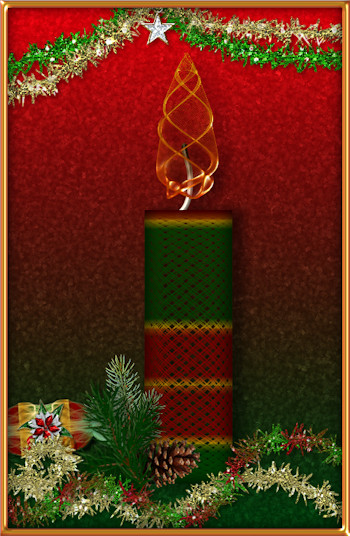
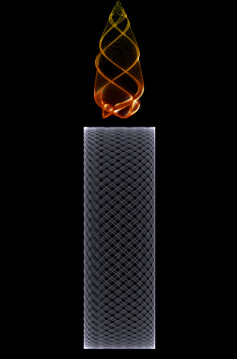
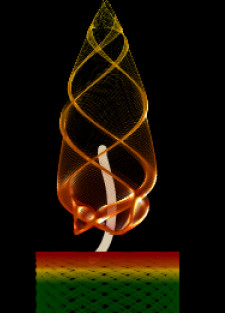
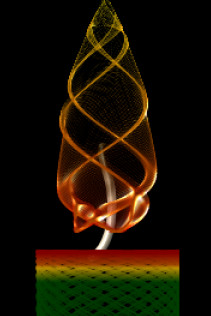
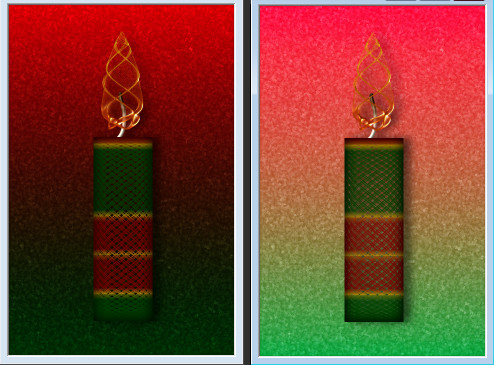
title-image

Candle Tutorial

PSP 7

image
This tutorial was created 15th Dec.2002©Copyright Artwork by EssexGirl
please do not copy it, or put it anywhere else without my written permission.

*NOTE*

Sometimes the links for filters change, it's difficult (and a lot of work) to
keep changing them on individual pages, so I have created a page with
links to filters and programs that I have used in my tutorials.
That way it is easier for me, because when there are changes I will
only have one page to update and hopefully better for you, because I'm
less likely to miss a page out when doing the updates :)

You will find links to filters/programs used in this tutorial Here
the link will open in a new window

Filters and programs used in this tutorial :-
Paint Shop Pro7
Dragonfly's Sinedots II filter you can get
Fantastic Machine's Paint Engine
OPTIONAL: Super Blade Pro

Materials :-
There is a text file included in the zip, if you don't know where to place the items.
My sg_candle.cfg and golden smoothie SBP preset Here
Nanson's 'Ribbon' gradient, it is on page 4. There are some
beautiful gradients to be found, so take a look around while
you're there, A link is Here

some images have been made smaller to shorten file size


Step 1.
Open a new image 200 x 200 transparent
Flood fill with a dark colour, it doesn't matter what colour
you use, because you can change the background later.

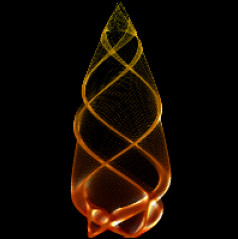
Add a new layer naming it 'flame'.
Go to Effect...Plugin Effects...Dragonfly...Sinedots
Open the sg_candle.cfg and choose the challenge_M preset.

If you are new to sinedots and don't know how to open
the .cfg file click HERE for more information

Some presets use different 'blend' settings and it is
important for this tutorial to make sure that the blend
in the sinedots setting is set to 'screen' like this:-

image

image


Step 2.
Go to Effects...Geometric Effects...Perspective Vertical...
Make the difference -100 (minus 100)

image

Make the foreground colour of your palette
#C00000 dark red and the background #FFFF40 yellow.
Change the foreground style to gradient fill,
click on the foreground styles box and in
the dialogue box choose these settings
style=linear gradient, angle=0,
repeats=0, invert gradient unticked

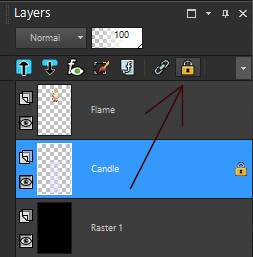
Open the layer palette and on the 'flame' layer click the
red X on the padlock (far right of the layer) to remove it.
This will protect the transparent areas of the layer when
it is flood filled. Flood fill the layer with gradient
and then click the padlock to replace the X.

image

You can try different colour combinations, a plain colour
or leave the colour of the flame untouched if you prefer.
Another optional step is to apply SuperBladePro, either
instead of, or as well as flood filling with colour.

Go to Selections...Select All...(ctrl+A)
Selections...Float...(ctrl+F)
Go to Effects...Plugin Effects...
Flaming Pear...SuperBladePro...
Apply the sg_golden smoothie preset,
or another of your choice.

image

The colour of my flood fill shows through the SBP preset.


Step 3.
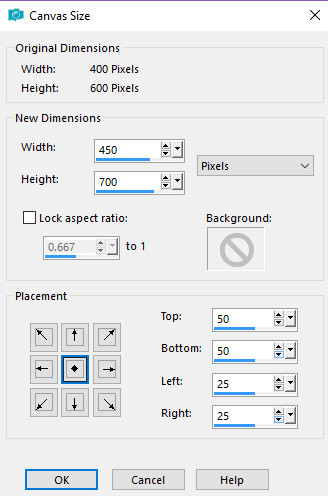
Go to Image...Canvas size...
Change the canvas size to 400 x 600 in the
image placement section tick the centre
horizontally box, untick the centre vrtically box,
0 in the top and 400 in the bottom boxes.

image

Change your palette foreground back to the dark
colour that you used to flood fill the background
layer and the style back to solid fill. Make the
bottom layer active and flood fill with your dark
colour, then add a new layer naming it 'candle'.


Step 4.
We need to open a new image to make the candle.
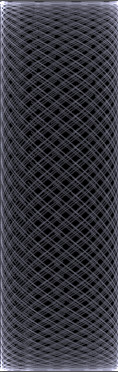
Open a new image 120 x 370 transparent.
You can add a new layer and flood fill if you
want to, but it's not necessary as we will be copying
and pasting the the sinedots candle on to the main
image straight away, I have only done it here so that
the image is visible in the screenshot.

Go to Effects...Plugin Effects...Dragonfly...Sinedots...
Choose one of the candle presets that are in the
sg_candle.cfg there are 2 to choose from.
This screenshot uses the candle1 preset

image


Step 5.
Go to Edit...Copy...(ctrl+C)
This image can be closed.
On your main image with the 'candle' layer active
Go to Edit...Paste...Paste as New Selection (ctrl+E)
Watch the co-ordinates at the bottom left of the screen
and place your candle shape at co-ordinates 142,213.
De-select.

image


Step 6.
If you want the candle to be more solid you can
duplicate the layer once or twice (more if you
want to). Make the 'candle' layer active, go to
Layers...Duplicate...repeat (ctrl+y) until you
are happy with the thickness, then turn off the
visibility of the background and flame layers by
clicking the glasses in the layer palette. Go to
Layers...Merge...Merge Visible...
then re-name the merged layer 'candle'.
Turn the visibility of all the layers back on.

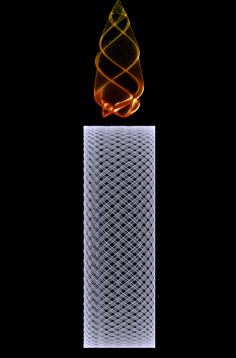
I duplicated my candle layer twice, then merged
the candle and duplicates together.
image

If you want to change the colour of your candle,
you can do it in the same way as the flame in step 2,
by locking the layer transparency and flood filling
with a gradient, pattern fill, or solid fill. Don't
forget to put the X back on the padlock afterwards.

I flood filled my candle with a gradient called
'ribbon' which I got from Nanson's Place. If you
want to use the same one there is a link at the top
of the page. You might find something you like
better while you're looking around :)

These are the settings I used for the gradient fill.
Angle=0, repeats=2 invert gradient ticked

image

Depending on the colours you use and whether you want
your candle to be on a light or dark background, you
may want to duplicate and merge the candle layer again,
this is just personal taste. I duplicated my candle
layer again and felt that looked better. Try it, if you
don't like it you can always delete the duplicate layer.
If you decide to keep it don't forget to make the other
layers invisible and merge visible the candle layers.


Step 7.
Make your bottom layer active and
add a new layer, naming it 'wick'.
Make the foreground solid fill in a
beige or fawn colour. I used #D7CAAF
Make the background palette style null

Use the Draw Tool, type= Freehand line, width=8
antialias ticked, create as vector unticked.
and draw a line for the wick. I curved mine a little.

image

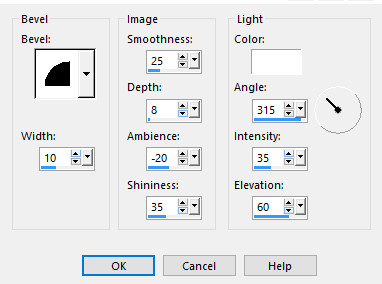
Go to Effects...3D Effects...Inner Bevel...
Use the round preset, but change the width
and the depth down to 2. You will find the
presets in the dropdown list at the top centre


Step 8.
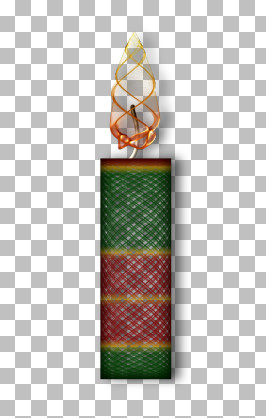
Make the 'candle' layer active.
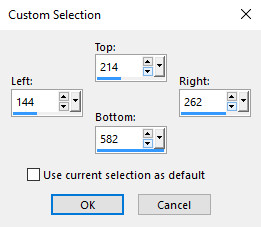
Double click on the Selections Tool
In the dialogue box use these settings
left=144, right=262, top=214, bottom=582
Then go to Selections...Invert...
Press the delete key (but don't de-select yet).
This will neaten up any ragged edges.
Go back to Selections...Invert...

Add a new layer and go to
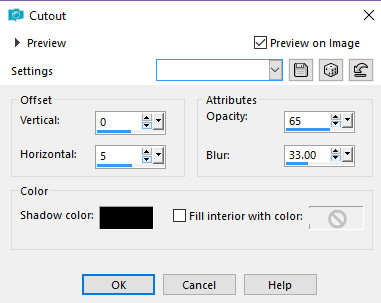
Effects...3D Effects...Cutout...
use these settings
Vertical Offset=0, Horizontal Offset=5,
Opacity=67, Blur=33.8, colour=black
Add a new layer and repeat the Cutout changing
the Horizontal Offset to -5 (minus 5)
This puts a shadow down the sides of the candle
to make it appear more rounded, if you want a flat
candle, you can omit this step.

Now we can merge the whole candle, but turn off
the visibility of the background layer first.
Then Merge Visible and turn visibility back on.


Step 9.
To give me more space for adding a drop
shadow and some decoration to my candle
I resized the candle layer.

The method I am using for this tutorial uses
bicubic resample. I can't remember where I learnt
it, but it produces good results. If you want to
resize in a way that you are more familiar with
please do so, but whatever method you use make
sure that the all layers box is not ticked.

Make the 'candle' layer active, go to Image...Resize...
Change the resize type to bicubic resample.
The 'Maintain Aspect Ratio' box should be ticked
and the 'All Layers' box should be unticked.
In the percentage area put 90 and click ok.
Repeat the resize once (or more if you want
the candle to be smaller). You should find that
the image doesn't need to be sharpened when
resizing this way. Click on it with the
magnifying glass if you want a closer look.

At this point I resized my whole image using the
same method but with the all layers box ticked.
If you prefer to, you can lave your resizing
to the end of the tutorial.
I repeated the 90% resizing until my image was
almost the size that I wanted and used pixel
size instead of percentage for the last resize.

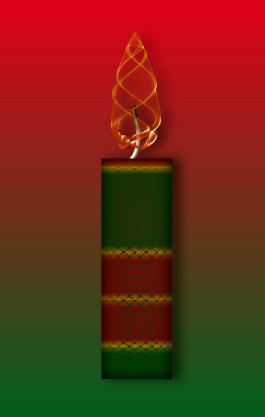
Now for the shadow.
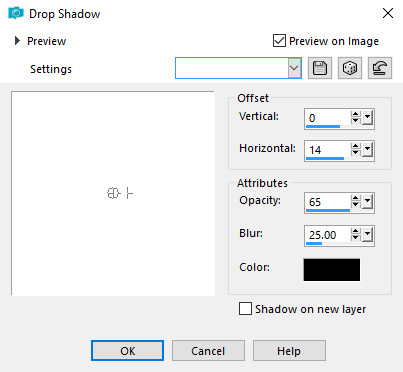
Go to Effects...3D Effects...Drop Shadow...
Use these settings
Vertical Offset=0, Horizontal Offset=14,
Opacity=65, Blur=23.5, colour=black

Next we will change the background
Make the background layer active and flood fill
or decorate as you like. I flood filled mine with
PSP's Red-Dark Green gradient, angle=180 repeats=0

image

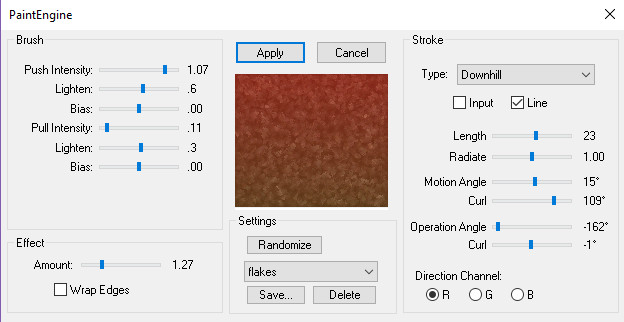
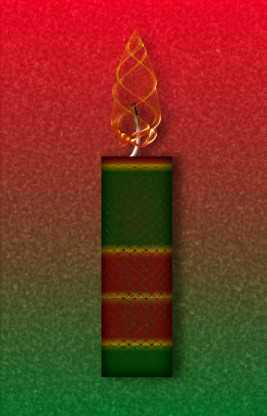
Then I applied Fantastic Machine's Paint Engine,
using the Flakes preset.

image


Step 10.
To finish off decorate your candle with tubes
and add a frame. If you add your decorations on
separate layers it makes it easy to move them
about and delete any that you decide not to use.
Add a small drop shadow to your tube layers
when your decorating is complete.

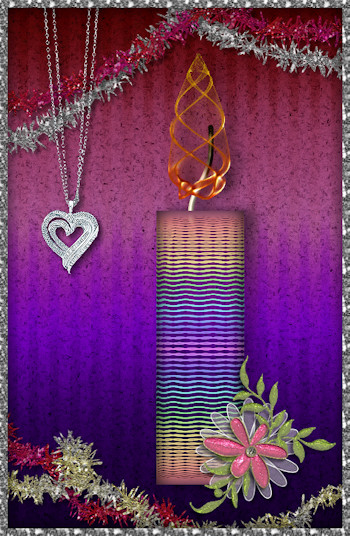
For this example I used the Sinedots 'candle2'
preset and flood filled it with a pastel gradient.

image


This tutorial was inspired by a picture made by
Sandy Ralph, otherwise known as Moonlight Lady
and I'd like to thank her for the inspiration.
If you'd like to visit her site and see some of
the lovely pictures in her gallery click Here

I'd also like to give a big thankyou to my testers.

I hope you enjoyed this tutorial.
To see my other tutorials click Here


If you wish to contact me you can find an email address to use included on my Site Map
Home